

Kale Capsules vs Kale Powder is mainly a question about routine. Capsules reduce direct taste and use a fixed count. Powder gives you a scoopable ingredient for drinks or food, but it adds measuring, mixing, texture, and cleanup.
The current Secrets Of The Tribe kale product is sold in capsule form, so the useful comparison is not whether one format is universally better. It is whether a fixed capsule routine fits you better than loose green powder that needs preparation.
This guide compares taste, prep time, portability, serving consistency, labels, cost, storage, and medication questions. It also explains why a capsule may contain kale powder or kale extract, which means the ingredient panel matters more than the format name.
Which Is Better: Kale Capsules or Kale Powder?
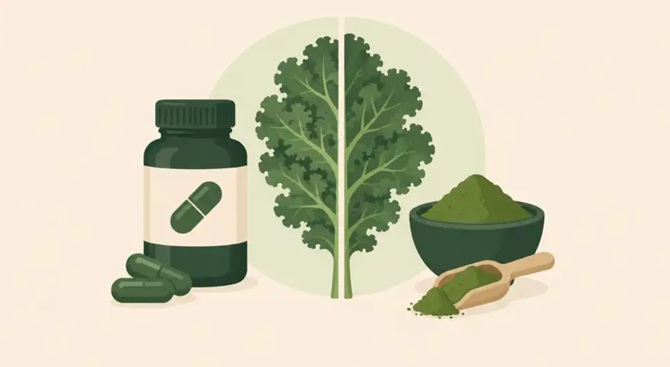
Kale capsules are usually easier if you want little taste, quick use, and a repeatable capsule count. Kale powder is usually easier if you want to mix kale into smoothies, yogurt, sauces, or other foods and do not mind measuring a scoop.
Neither format is automatically more concentrated or more useful. The answer depends on what the label lists, how much is in one serving, and whether the product uses dried leaf powder, an extract, or a blend.
The practical answer
Choose capsules for convenience, portability, and taste avoidance. Choose powder for mixing flexibility and a food-style routine. Compare the actual grams or milligrams per serving before deciding.
What Is Actually Inside Each Format?
Kale capsules may contain dried kale leaf powder, kale extract, or a blend. The capsule shell and inactive ingredients are separate from the kale. A clear label should identify the kale form, amount per serving, capsule material, and any fillers or flow agents.
Kale powder is usually dried kale milled into a fine powder. Some products use whole leaf powder. Others use juice powder, extract powder, or a greens blend with several plants.
Capsules can simply hold powder
Some capsules are measured portions of kale powder inside a shell. In that case, the main difference is delivery. Other capsules use an extract, so do not assume every capsule matches loose powder.
Look for kale, kale leaf, Brassica oleracea wording, dried leaf powder, extract, or blend on the label.
Kale Capsules vs Kale Powder: Quick Comparison
| Feature | Kale capsules | Kale powder |
|---|---|---|
| Taste | Usually minimal during use | Green, earthy, grassy, or bitter |
| Preparation | Swallow as directed | Measure and mix |
| Serving control | Fixed by capsule count | Measured by scoop, spoon, or weight |
| Portability | Easy in the original bottle | Bulkier and may need a scoop |
| Texture | No powder texture if swallowed whole | May feel gritty or clump |
| Label focus | mg, capsule shell, fillers | grams, scoop size, additives |
The format does not tell you the full amount of kale. A capsule serving and a scoop of powder may differ greatly in weight.
Which Format Is Easier for Taste and Preparation?
Capsules usually win for taste avoidance. You may notice a green smell when opening the bottle, but the contents do not sit on the tongue.
Powder has a clear leafy flavor. Water makes it obvious. Fruit, cocoa, yogurt, nut butter, or a strong smoothie can mask it better. Blending usually works better than stirring.
Do not adjust the amount by taste
Do not add extra powder because a smoothie hides the flavor. Do not take extra capsules because they are easy to swallow. Use the serving on the current label.
Capsules require almost no preparation. Powder is convenient only if you already make drinks or foods that can carry it.
Which Format Gives More Consistent Measuring?
Capsules give you a fixed unit. If one serving is two capsules, you count two capsules. Powder can vary if a scoop is heaped, compressed, wet, or not level.
Powder may look more flexible, but the label still defines the serving. A partial scoop is not automatically right, and a larger scoop is not automatically better.
Compare the full serving
For capsules, compare milligrams per serving, not only milligrams per capsule. For powder, compare grams per serving and follow the measuring directions.
If precision matters, a clean scale can be more consistent than an estimated spoonful, but it should not replace the labeled amount.
Can Kale Powder Go Into Food or Drinks?
Kale powder can be mixed into smoothies, yogurt, oatmeal, soups, sauces, or dips if the product directions allow it. Use a portion you know you will finish.
A large blender batch can create uncertainty. If you leave half the drink behind, you may not consume the full serving. Do not divide a batch across several days unless the label and storage directions support that plan.
Keep the container dry
Use a dry scoop and close the package quickly. Moisture can cause clumping and make the powder harder to measure.
Which Format Works Better for Travel?
Capsules are usually easier for travel because they are dry, compact, and pre-portioned. Keep them in the original labeled bottle so the serving directions, ingredients, lot number, and expiration date remain available.
Powder can travel, but it needs a secure container, measuring tool, and something to mix it into. Loose powder in an unmarked bag can also create confusion.
Protect both formats
Keep capsules and powder away from heat, moisture, damaged seals, and open containers. Do not rely on memory for the serving size.
What Should You Compare on the Labels?
| Label detail | Capsules | Powder |
|---|---|---|
| Kale form | Leaf powder, extract, or blend | Leaf powder, juice powder, extract, or blend |
| Amount | Milligrams per serving | Grams or milligrams per serving |
| Other ingredients | Shell, fillers, flow agents | Flavors, sweeteners, carriers, other greens |
| Serving method | Capsule count and food directions | Scoop, spoon, weight, and mixing directions |
| Quality details | Seal, lot number, expiration date | Seal, moisture control, lot number, expiration date |
Do not compare package size alone. A large tub and a small bottle can have very different serving counts and amounts of kale per serving.
What Does the Current Capsule Product Page Tell You?
The current Secrets Of The Tribe kale capsule page lists capsules as the product form, offers 60-count and 120-count sizes, and gives a direction of two capsules twice daily with food. This shows the main capsule advantage: the routine is built around a count rather than a scoop.
The bottle in your hand remains the final reference. Check its Supplement Facts, serving size, warnings, safety seal, lot number, and expiration date before use.
How Should You Compare Cost?
Compare cost per labeled serving, then compare the amount and form of kale in that serving. A low package price is not useful if the serving contains less kale, includes unwanted ingredients, or creates waste because you dislike the format.
Capsules include encapsulation and packaging. Powder may offer more physical material per container, but only if you measure and finish it consistently.
Use simple math
Divide the package price by the number of servings. Then compare grams or milligrams and note whether the ingredient is powder, extract, or blend.
Do Capsules or Powder Replace Fresh Kale?
Do not assume capsules or powder are identical to a serving of fresh kale. Drying, milling, extraction, serving weight, and added ingredients can change the product. A few capsules may contain far less physical material than a serving of vegetables.
Fresh kale and kale supplements also use different label systems. Fresh food uses Nutrition Facts. Capsules and many supplement powders use Supplement Facts.
Who Should Read the Label Especially Carefully?
Read the label carefully if you take medication, are pregnant or nursing, have a medical condition, prepare for surgery, or use several supplements. Show the exact product to a clinician or pharmacist when the warning section applies.
Kale is a vitamin K-rich leafy green. If you use warfarin or another medicine whose instructions depend on consistent vitamin K intake, ask your clinician or pharmacist before adding a kale supplement. Do not change your medicine or suddenly change your usual vitamin K intake on your own.
Bring complete information
Bring the Supplement Facts panel, other ingredients, serving size, product form, and your current medication and supplement list.
What Product Red Flags Should You Check?
For capsules, watch for a broken seal, damaged bottle, wet or stuck capsules, unusual odor, missing lot number, or expired date. For powder, watch for moisture, hard clumps, mold-like odor, insects, damaged packaging, or a wet scoop stored inside.
Do not swallow capsules or taste powder from a container with clear quality concerns. Contact the seller with photos, lot number, expiration date, and a description of the issue.
Checklist: How to Choose Kale Capsules vs Kale Powder
Use this checklist before choosing a format. It helps you compare routine fit, taste, serving amount, added ingredients, and label warnings without relying on package design.
Define your priority
Decide whether you care most about avoiding taste, reducing preparation, mixing into food, portability, or fixed serving control.
Confirm the kale form
Look for dried leaf powder, juice powder, extract, or blend wording. Do not assume every product contains the same material.
Compare serving amounts
Check milligrams or grams per full serving. Do not compare one capsule with one scoop.
Read other ingredients
For capsules, check the shell and fillers. For powder, check flavors, sweeteners, carriers, and other greens.
Test the routine honestly
Choose capsules only if you can swallow them comfortably. Choose powder only if you will measure, mix, and finish it consistently.
Check medication context
Ask a clinician or pharmacist if you use warfarin, take other medications, are pregnant or nursing, or have a medical condition.
Compare cost per serving
Divide price by labeled servings, then compare the amount and form of kale in each serving.
Inspect quality details
Check the seal, lot number, expiration date, storage directions, and container condition before use.
FAQ on Kale Capsules vs Kale Powder
Are kale capsules the same as kale powder?
Sometimes capsules contain kale powder, but other products use extracts or blends. Check the ingredient panel.
Which has less taste?
Kale capsules usually have less direct taste because the contents stay inside the capsule until swallowed.
Which is easier to measure?
Capsules are usually easier because the serving uses a fixed count. Powder requires a scoop, spoon, or weight measurement.
Can kale powder go in a smoothie?
Yes, if the directions allow it. Blend the measured serving into a portion you will finish.
Are kale capsules better for travel?
Usually yes. Capsules are compact and pre-portioned, but keep them in the original labeled container.
Does powder contain more kale than capsules?
It may contain more grams per serving, but this varies. Compare the actual serving amount on both labels.
Do kale supplements replace fresh kale?
Do not assume they do. Supplement serving size and processing differ from fresh vegetables.
Can I use kale supplements with warfarin?
Ask your clinician or pharmacist first. Consistent vitamin K intake matters for people using warfarin.
Glossary
Kale capsules
A supplement format that places kale powder, extract, or a blend inside capsule shells.
Kale powder
Dried kale material milled into powder for mixing into food or drinks.
Brassica oleracea
The botanical species name used for kale and several related vegetables.
Leaf powder
Dried leaf material ground into a fine powder.
Extract
A prepared ingredient made from plant material through an extraction process.
Capsule shell
The outer casing of a capsule, often made from gelatin or plant-based cellulose.
Serving size
The amount the label defines as one serving, such as a capsule count or scoop weight.
Supplement Facts
The label panel that lists serving size, dietary ingredients, and amounts per serving.
Conclusion
Kale Capsules vs Kale Powder comes down to taste, preparation, serving control, portability, and label details. Capsules fit a fast fixed-count routine, while powder fits people who will measure and mix it consistently.
Sources Used
Current kale capsule product page with format, serving directions, and product details – secrets.shop/products/kale-capsules
Dietary supplement labeling requirements and Supplement Facts guidance – fda.gov/food/dietary-supplements-guidance-documents-regulatory-information/dietary-supplement-labeling-guide
Kale food composition database entry – fdc.nal.usda.gov/food-search
Vitamin K and warfarin consistency guidance – ods.od.nih.gov/factsheets/VitaminK-Consumer
General supplement and medication interaction guidance – fda.gov/consumers/consumer-updates/mixing-medications-and-dietary-supplements-can-endanger-your-health

