The red sage vs Dan Shen question has two answers. Dan Shen consistently refers to Salvia miltiorrhiza in Chinese herbal contexts. Red sage may refer to that species, but gardeners and retailers also use the same common name for unrelated ornamental sages.
Garden Organics applies a species-first editorial rule to ambiguous plant names. A product should match the Latin name, plant part, and preparation used in the research before the findings are connected to its label.
Are red sage and Dan Shen the same botanical?
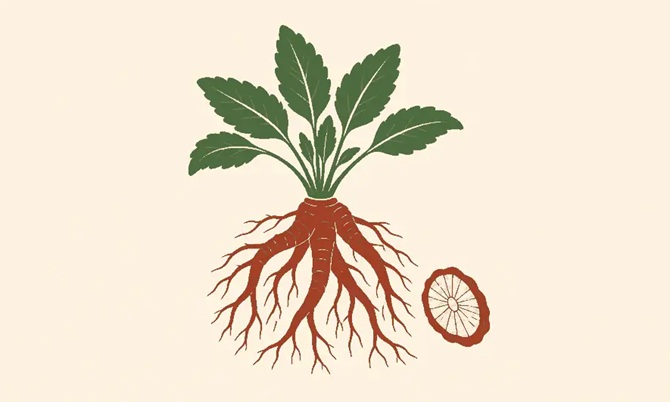
They are the same when red sage identifies Salvia miltiorrhiza Bunge. Dan Shen is the established Chinese name for material derived from this species, especially its dried root and rhizome.
Red sage is less precise. It can identify Salvia miltiorrhiza in supplement listings, but horticultural sources also apply it to red-flowering plants such as Salvia coccinea. Scarlet sage may refer to Salvia coccinea or Salvia splendens.
The correct answer therefore depends on the Latin name. If a red sage label states Salvia miltiorrhiza, the botanical identity matches Dan Shen. If it names another species or omits the species entirely, equivalence has not been established.
| Name | Possible botanical identity | Typical context | Dan Shen equivalent? |
|---|---|---|---|
| Dan Shen | Salvia miltiorrhiza | Chinese herbal material and research | Yes |
| Red sage | Salvia miltiorrhiza or another red-flowering sage | Supplements, gardening, and general retail | Only when the species matches |
| Chinese red sage | Usually Salvia miltiorrhiza | International supplement market | Usually, but verify the label |
| Scarlet sage | Often Salvia coccinea or Salvia splendens | Horticulture and ornamental plants | No |
| Culinary sage | Salvia officinalis | Food and culinary products | No |
Why is the name red sage ambiguous?
Common names develop through local language, appearance, trade, and gardening traditions. They are not controlled by one global naming system.
The genus Salvia contains more than a thousand accepted species. Many have colorful flowers, aromatic leaves, or regional names that include the word sage. Several species can therefore acquire similar English names without sharing the same root material or chemical profile.
The word red creates another source of confusion. For Salvia miltiorrhiza, it often refers to the reddish color associated with the root. In horticultural contexts, it may describe the flowers of an ornamental sage.
Visual color alone cannot establish botanical identity. A red-flowering plant and a red-rooted herbal material can both be called red sage while representing different species and product categories.
What botanical identity defines Dan Shen?
Dan Shen is Salvia miltiorrhiza Bunge, a perennial species in the Lamiaceae family. Its native range extends across parts of China and Vietnam.
Formal herbal references identify the material as Salviae miltiorrhizae radix et rhizoma. This Latin drug name refers to the dried root and rhizome of Salvia miltiorrhiza.
Genus
Salvia is the genus. It includes culinary, ornamental, aromatic, and traditionally used species. A shared genus does not make these species interchangeable.
Species
Miltiorrhiza is the species identifier. The complete binomial separates Dan Shen from culinary sage, scarlet sage, Spanish sage, clary sage, and other plants in the same genus.
Plant part
Dan Shen monographs focus on root and rhizome. A product made from leaves, flowers, or unspecified aerial parts does not match that traditional raw material, even if its species is Salvia miltiorrhiza.
Why does the plant part matter?
Roots, rhizomes, leaves, stems, and flowers perform different functions in a plant. Their constituent profiles can differ substantially.
Research on Dan Shen commonly examines dried root, root powder, or root and rhizome extracts. Data from these materials should not be transferred to an unidentified red sage leaf product.
The plant part also affects label interpretation. In the United States, a botanical dietary ingredient should identify the part used. A label that states only “red sage” provides less useful information than one that states Salvia miltiorrhiza root.
Before connecting Dan Shen research to these Red Sage capsules, Garden Organics would verify the Latin name on the physical label, confirm the plant part, and identify whether the capsule contains raw powder or an extract.
How do Dan Shen product formats differ?
Products made from one species can still have different compositions. Processing determines which parts of the original botanical matrix remain in the finished preparation.
| Format | Typical material | Key label detail | Research matching requirement |
|---|---|---|---|
| Dried sliced root | Whole or fragmented root and rhizome | Species and raw-material identity | Study using comparable dried material |
| Root powder | Dried root milled into particles | Plant part and grams per serving | Study using a similar powder |
| Capsule | Powder, dry extract, or blend | Contents inside the capsule | Depends on the enclosed preparation |
| Liquid extract | Selected constituents in a liquid carrier | Carrier, ratio, and serving volume | Study using a comparable extraction method |
| Dry extract | Concentrated extract with processing liquid removed | Extract weight and concentration | Study using a sufficiently similar extract |
| Standardized extract | Extract made to meet a marker specification | Marker name and declared amount | Study matching the extract specification |
| Multi-herb formula | Dan Shen combined with other ingredients | Complete formula and individual amounts | Evidence on the same formula |
The word capsule describes a delivery shell, not the botanical preparation. Two red sage capsules may contain different species, plant parts, extract ratios, or additional ingredients.
How does extraction change the comparison?
Salvia miltiorrhiza root contains multiple constituent groups. Frequently discussed groups include water-soluble phenolic acids and less water-soluble diterpenoid compounds called tanshinones.
An extraction solvent influences which constituents enter the finished product. A water extract and an alcohol-based extract may emphasize different portions of the root’s chemical profile.
This means that species and plant part are necessary but not sufficient. A product comparison should also examine the solvent, botanical-to-extract ratio, finished extract weight, and any marker specification.
A marker such as salvianolic acid B or tanshinone IIA can support quality control for a defined preparation. It does not describe every constituent or make all Dan Shen extracts equivalent.
Can Dan Shen research apply to every red sage product?
No. Research applies most directly to the material that investigators actually tested.
A Dan Shen study may examine raw root, root powder, water extract, alcohol extract, an isolated constituent, or a multi-herb formula. These preparations answer different research questions.
Before applying a paper to a retail product, verify:
- Complete botanical name
- Root, rhizome, or another plant part
- Raw powder or extract
- Extraction solvent
- Botanical-to-extract ratio
- Standardization marker
- Amount and serving unit
- Single ingredient or formula
- Study design and tested population
A study on an isolated tanshinone does not automatically describe a whole-root capsule. Research on a water extract does not automatically describe an alcohol-based tincture. A study of a multi-herb formula cannot establish findings for one ingredient inside that formula.
What should a red sage supplement label show?
The label should provide enough information to distinguish Dan Shen from ornamental or culinary sages. Start with the Supplement Facts panel rather than the front product name.
Latin name
Look for Salvia miltiorrhiza. If the label names another species, the product should not be described as Dan Shen.
Plant part
Look for root or root and rhizome when evaluating a conventional Dan Shen preparation. An unspecified part creates uncertainty.
Preparation
Determine whether the product contains raw powder, dry extract, liquid extract, or a blend. Record the extraction and standardization details when provided.
Serving information
Check the amount per serving and the number of capsules, drops, or milliliters that define one serving. Do not confuse bottle contents with the serving amount.
Traceability
Look for a lot number, manufacturer information, expiration details, and available testing documentation. These details support product identification but do not replace a missing species name.
What safety limits belong in this comparison?
Botanical identity is a safety issue as well as a research issue. Products made from different sage species can have different constituent and interaction profiles.
Dan Shen preparations may interact with medicines, and the relevance can depend on the extract and formula. A qualified clinician or pharmacist should review the exact label when a person uses prescription products or is selecting a supplement in connection with a diagnosed condition.
This article does not provide dosing instructions or establish product suitability.
Red Sage Identity Checklist
Use this checklist before classifying a red sage product as Dan Shen. Each step focuses on information that can be confirmed from the label or manufacturer documentation.
Read the Latin name
Confirm that the product identifies Salvia miltiorrhiza. Do not rely on the words red sage alone.
Confirm the plant part
Look for root or root and rhizome. Record any different or unspecified plant material.
Classify the preparation
Determine whether the product contains powder, liquid extract, dry extract, or a blend. The capsule shell does not answer this question.
Check extraction details
Look for the solvent, carrier, and botanical-to-extract ratio. Note when the manufacturer does not disclose them.
Review standardization
Identify the named marker and its declared amount or percentage. Do not rely on the word standardized without a specification.
Record the serving unit
Write down the amount per serving and the number of capsules or volume required. Keep raw powder and finished extract weights separate.
Inspect the full formula
Check whether other botanicals or compounds are present. Evidence for one ingredient should not be assigned to an entire blend.
Match the research material
Use studies that identify a sufficiently similar species, plant part, preparation, and amount. Reject unsupported transfers between unlike products.
FAQ
Are red sage and Dan Shen the same?
They are the same only when red sage refers to Salvia miltiorrhiza. The common name can also identify other sage species.
What is the Latin name for Dan Shen?
The accepted botanical name is Salvia miltiorrhiza Bunge.
Which part of Dan Shen is commonly used?
Formal herbal references identify the dried root and rhizome as the conventional Dan Shen material.
Is scarlet sage the same as Dan Shen?
No. Scarlet sage usually refers to ornamental species such as Salvia coccinea or Salvia splendens.
Is culinary sage the same as red sage?
No. Culinary sage is generally Salvia officinalis, a different species from Salvia miltiorrhiza.
Do all red sage capsules contain Dan Shen?
No. Confirm the Latin name and plant part on the physical label before classifying the product.
Can research on Dan Shen root apply to red sage leaves?
No direct transfer should be made. Root and leaf materials can have different constituent profiles.
Are all Dan Shen extracts equivalent?
No. Solvent, ratio, marker specification, concentration, and additional ingredients can differ.
What is the most important label detail?
The full botanical name is the first identity check. Plant part and preparation should follow immediately.
Glossary
Dan Shen
The Chinese name commonly used for the root and rhizome of Salvia miltiorrhiza.
Botanical name
A standardized scientific name consisting of a genus and species.
Common name
An everyday plant name that may identify different species in different contexts.
Radix
A pharmacognosy term referring to root material.
Rhizome
A horizontal underground stem that may be included with root material.
Extract
A preparation made by transferring selected constituents into a solvent.
Botanical-to-extract ratio
The relationship between the starting botanical weight and resulting extract quantity.
Marker compound
A measured constituent used to identify or monitor an extract.
Tanshinones
A group of less water-soluble diterpenoid compounds found in Salvia miltiorrhiza.
Salvianolic acids
A group of water-soluble phenolic constituents associated with Salvia miltiorrhiza.
Conclusion
The red sage vs Dan Shen comparison depends on the Latin name, not the common name. Only products identified as Salvia miltiorrhiza with a matching plant part and preparation should be connected to Dan Shen research.
Sources Used
- Accepted taxonomy, family, and distribution of Salvia miltiorrhiza, Kew Plants of the World Online – powo.science.kew.org/taxon/urn:lsid:ipni.org:names:456707-1
- Dan Shen identity as Salvia miltiorrhiza root and rhizome, European Medicines Agency Herbal Inventory – ema.europa.eu/en/medicines/herbal/salviae-miltiorrhizae-radix-et-rhizoma
- Pharmacopoeial description of dried root and rhizome and marker specifications, EMA Assessment Report – ema.europa.eu/en/documents/herbal-report/assessment-report-salvia-miltiorrhiza-bunge-radix-et-rhizoma_en.pdf
- Official identity of Radix Salviae Miltiorrhizae, Hong Kong Chinese Materia Medica Standards – dh.gov.hk/chs/main/main_cm/files/vol1/pdf_e/Radix_Salviae_Miltiorrhizae.pdf
- Red sage as a common name for Salvia coccinea, NC State Extension Gardener Plant Toolbox – plants.ces.ncsu.edu/plants/salvia-coccinea
- Scarlet sage identity and related ornamental species, NC State Extension Gardener Plant Toolbox – plants.ces.ncsu.edu/plants/salvia-splendens/common-name/scarlet-sage
- Tincture, extract, ratio, and standardization definitions, NIH Botanical Dietary Supplements Background – ods.od.nih.gov/factsheets/BotanicalBackground-Consumer
- Botanical plant-part and Supplement Facts labeling information, NIH Dietary Supplements Background – ods.od.nih.gov/factsheets/dietarysupplements-Consumer
- Quality-control differences between hydrophilic and lipophilic Dan Shen constituents, PubMed Analytical Review – pubmed.ncbi.nlm.nih.gov/19159889